Kilimanjaro Trekking
Rongai Route
Difficulty Moderate · 75% (6d) / 85% (7d) summit success · 6 days or 7 days
Route Overview
Why climb the Rongai Route?
The Rongai Route is the only Kilimanjaro path that approaches from the north, near the Kenyan border. It is drier than the southern routes, far less crowded, and offers a true wilderness feel through pine forests and remote moorland.
Because the northern side is in a rain shadow, Rongai is the best route during the wet season (April–May, November). Wildlife sightings — including buffalo and elephant tracks — are more common than on other routes.
Route Map
Northern approach from Nale Moru, ascending through pine forest and moorland to the Kibo saddle. Descent via the Marangu Route.
Altitude Profile
Nale Moru Gate 1,950m → Simba 2,625m → Kikelewa 3,600m → Mawenzi Tarn 4,330m → Kibo 4,700m → Uhuru 5,895m. Descent via Marangu.
6-Day Itinerary
Starting from US$1,890 per person
- 1
Nale Moru Gate to Simba Camp (2,625m)
~4 hours through pine forest and farmland.
- 2
Simba to Kikelewa Caves (3,600m)
~6 hours through moorland with views of Kibo and Mawenzi.
- 3
Kikelewa to Mawenzi Tarn (4,330m)
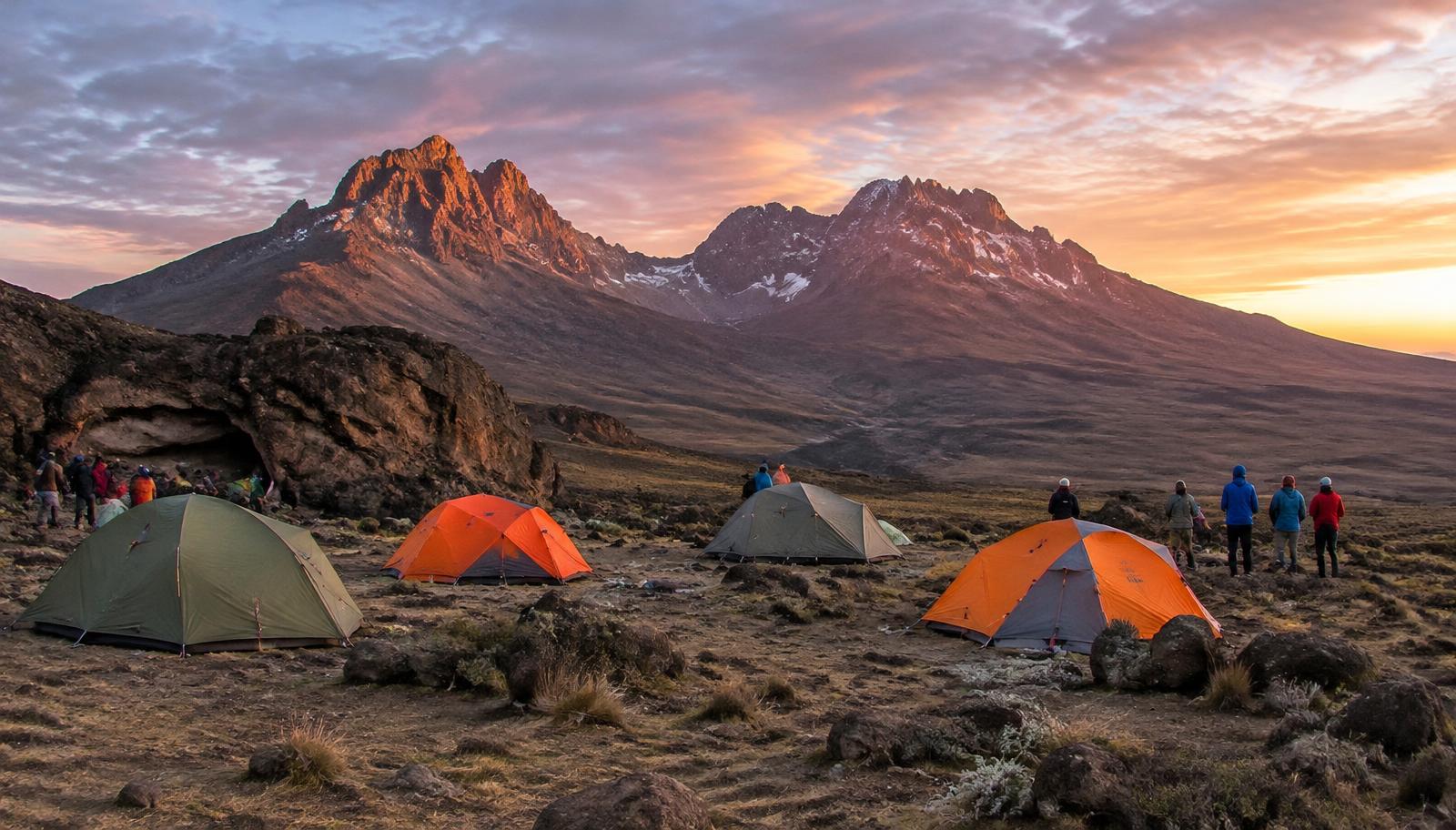
Steep ascent to a stunning alpine tarn beneath Mawenzi's jagged peaks.
- 4
Mawenzi Tarn to Kibo Hut (4,700m)
~5 hours across the saddle. Early dinner, rest.
- 5
Summit Day → Horombo Hut
Midnight summit attempt via Gilman's Point and Uhuru, descent to Horombo.
- 6
Horombo to Marangu Gate
~6 hour descent through forest, transfer to Moshi.
7-Day Itinerary
Starting from US$2,050 per person
- 1
Nale Moru Gate to Simba Camp (2,625m)
~4 hours through pine forest.
- 2
Simba to Second Cave (3,450m)
Shorter day for better acclimatisation.
- 3
Second Cave to Kikelewa (3,600m)
~4 hours through moorland.
- 4
Kikelewa to Mawenzi Tarn (4,330m)
Steep climb to the dramatic tarn.
- 5
Mawenzi Tarn to Kibo Hut (4,700m)
~5 hours, summit prep.
- 6
Summit Day → Horombo Hut
Midnight start, Uhuru Peak, descent.
- 7
Horombo to Marangu Gate
Forest descent, certificate, transfer.
Pricing
All-inclusive group price per person. Solo & private rates on request.
| Duration | Group of 2 | Group of 4+ | Solo |
|---|---|---|---|
| 6 days | US$1,890 | US$1,740 | US$2,240 |
| 7 days | US$2,050 | US$1,900 | US$2,400 |
What's Included
- All park, camping & rescue fees
- Professional KPAP-partner guides (1:2 ratio)
- Ethical porters (correct loads, fair wages)
- Mountain cook + 3 hot meals daily
- Mountain tents, mattresses & dining tent
- Round-trip transfers from Moshi/Arusha
- Bottled & filtered water on the mountain
- Pulse oximeter daily health checks
- Emergency oxygen & first aid kit
- Summit certificate
What's Excluded
- International flights
- Tanzania visa (US$50–100)
- Travel & evacuation insurance (required)
- Personal climbing gear (rentable in Moshi)
- Tips for guides, cook & porters
- Drinks & snacks beyond meals
- Pre/post-climb accommodation
Recommended Packing List
- Waterproof hiking boots (broken in)
- 4-season sleeping bag (-15°C rating)
- Down jacket + insulated mid-layer
- Waterproof shell jacket & trousers
- Trekking poles, headlamp + spare batteries
- Thermal base layers (top + bottom)
- Sun hat, beanie, balaclava & gloves
- Daypack 30L + 70L duffel (porters carry)
- Sunglasses (cat 3), SPF 50+ sunscreen
- Water bottles + bladder (3L capacity)
All gear is available to rent in Moshi from US$5/item/day.
Frequently Asked Questions
Why is Rongai better in wet season?+
The northern side of Kilimanjaro lies in a rain shadow, so it receives significantly less rainfall during April–May and November.
Is it really quieter?+
Yes — Rongai sees roughly 10% of total Kilimanjaro traffic. You'll often have entire camps to yourself.
What is the best time to climb Kilimanjaro?+
January–early March and June–October are the driest, clearest months. Full-moon dates fill up first — book 4–6 months ahead.
Do I need to be super fit?+
Kilimanjaro is a long, high-altitude trek — not a technical climb. If you can comfortably hike 6–7 hours a day at home, you can summit with proper acclimatisation.
How serious is altitude sickness?+
Above 3,000m, mild symptoms (headache, nausea) are common. Our guides carry pulse oximeters and emergency oxygen, monitor you twice daily, and descend at the first sign of severe AMS.
Are tips really required?+
Tipping is the cultural norm and a large part of your crew's income. We recommend US$300–400 per climber, pooled and distributed transparently.
What happens if I can't summit?+
You descend with an assistant guide while the rest of the group continues — no extra cost, no refund (park fees are non-refundable).
Where to stay before & after your Rongai Route climb
Most climbers spend 1–2 nights in Moshi before the trek for briefing and gear check, and 1 night after for a hot shower and celebration dinner. We've hand-picked hotels in Moshi and Arusha across every budget — from US$45 guesthouses to US$320 luxury 5-star. Book any of them through us as part of your climb package for 10–20% below public rates.
Extend your Rongai Route trek
Combine your Kilimanjaro climb with a Tanzania safari, Zanzibar beach break or acclimatisation warm-up — most guests do both.